mercoledì 7 aprile 2010

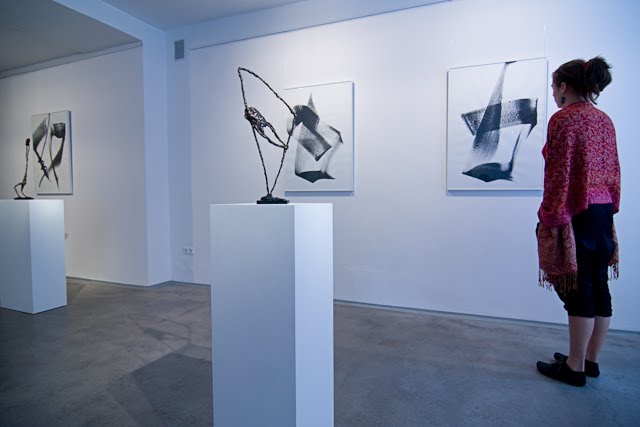
Nádler István and Sara Berti "A dialogue about the inexpressible" B55 Gallery, Budapest


22th april - 21th may 2010

Vernissage 22 april 7 p.m.

B55 GALLERY, BUDAPEST
1055 Budapest, Balaton u. 4.


Opening speech by
Máthé Andrea - Aesthete


Catalogue curated by
Győrffy László - Painter and art writer


LÁSZLÓ GYŐRFFY
A Dialogue about the Inexpressible


It would be quite easy to incorporate the joint exhibition of István Nádler and Sara Berti in a binary construction based on the different phases that the two artists are at within their artistic careers, but that would not aid the understanding of the relationship between their works, as the force connecting them is not derived from local differences but universal identities. Just as the two planes of one of Sara Berti’s sculptures (Parallel), the parallel universes of the two artists also meet at a single point. In contradiction of the laws of perspective, that single point is not in the distance but here and now, in the exhibition space of the gallery. István Nádler’s tempera and oil pastel graphic pieces and Sara Berti’s small bronze sculptures are defined not by the theoretical nature of language but by the act of doing, the impetus that transforms ineffable beams of energy into the medium of the two or three-dimensional object, modelling the performative nature of becoming against the static nature of being. According to Deleuze and Guattari, “the line does not connect two points, but runs between various points, rendering them indistinguishable”, hence the line “becomes a diagonal, breaking out of the captivity of the horizontal and the vertical”. The simultaneously introverted and impulsive world of the exhibition connects the internal with the external as a Möbius strip: István Nádler’s brushstrokes are a medium for the dynamism of the hand or, rather, the whole body, just as the surface of the sculptures is a medium for Sara Berti’s fingerprints. But the works on show superscribe the profane “interruptedness” (Bataille) of being thrown in the body, and point towards the sacrality of “continuity” – not through a reference to any specific religion or a personified God, but through an endeavour to achieve a vital completeness, bringing to the surface the unity of the ocean of awareness – exemplified by the sequential, repetitive flow of the sculptures and the graphic pieces as well.

The circularity and angle of incline of Sara Berti’s fragile figures, which balance at the borderline of being figurative, suggest an invisible axial presence; in the pictures of István Nádler, the vertical connecting sky and ground, indicative of the human entity, changes position in response to external movements like Foucault’s pendulum and often take on the body colours of Sara Berti’s forms that are kept secret by their material. The geometric or patterned motifs of the compositions of István Nádler and the interplay of the gestures that flow over them, and the opposed lines of force of the arching figures of Sara Berti generate a tension that does not create irresolvable conflict but rather a balance strung to the extreme: the internal curve of the human form is reminiscent of the Zen Buddhist meditation in which the body is the bow and the target for the arrow is enlightened awareness. Just as István Nádler’s compositions are mappings of relations beyond the material world, so Sara Berti’s small sculptures are not extremely reduced outlines of the image of the physical body, but rather transcendent projections of “the body without organs”: the abstraction of abstraction always leads into the realm of metaphysics – the intersection of converging lines is the seat of the incorporeal essence hidden in every person, the Self, which lives in us pure and imperturbable, whatever should happen to us.

Similarly to the cycle of piano pieces by György Ligeti (Musica Ricercata), the toolkit of the dialog built from the consonance of these two similar artistic Selves is sparse, but just right: the dialog between István Nádler and Sara Berti is built on the inexpressibility of that essential communication, so its true perception is not dependent on sense organs incapable of filtering out the “noise” of the external world, but rather a sensitive inner resonance.

martedì 30 marzo 2010

Vernissage "Limes" Fészek Művészklub - Budapest - 23 march 2010


Link of the photos of the exhibition:

http://www.feszek-muveszklub.hu/f00323.html

lunedì 22 febbraio 2010


coming soon:
solo exhibition
“LIMES”
23 March 2010 – 16 April 2010

Vernissage: 23 march at 6 p.m.


Fészek Művészklub

1073 Budapest, Kertész utca 36

http://www.feszek-muveszklub.hu/main.htm


http://artportal.hu/aktualis/kiallitasok/sara_berti_limes

venerdì 4 dicembre 2009

"Works - Studies and small works , european perspectives" - Berlin

Group exhibition.

Acudgalerie

Veteranenstr. 21
from 13.12. to 20.12.2009
daily 15.00 – 20.00

Artists

Sara Berti – Italy
Irma Markulin – Croatia
Elisabetta Lombardo – Italy
Laura Paniagua – Spain
Burgy Zapp – Germany
Mira Maar – Germany
Klaudija Sabo – Austria
Boris Duhm – Germany


The exhibition aims to an open approach to studies, sketches, small pieces in all media. Ranging from sculpture to painting to photography works wants to show diversity and similarity in European approaches to contemporary art.
Oftenly there is a distinct appeal in studies which enlightens the underlying ideas or approaches in a more open way.
Works wants to irritate you, works wants to seduce you, works wants to show art as a dialogue between artworks.

Opening day: 13th of December at 16:30.

giovedì 26 novembre 2009

Il percento per l’arte in Emilia-Romagna - presentazione volume e mostra fotografica.


a cura di
Claudia Collina, Carlo Tovoli, Andrea Zanelli
Fotografie di Andrea Scardova

Urban Center Bologna - Sala Borsa
3 dicembre 2009 - 16 gennaio 2010


Giovedì 3 dicembre 2009
ore 18
Urban Center Bologna

La S.V. è invitata alla presentazione del volume Il percento per l’arte in Emilia-Romagna La legge del 29 luglio 1949 n.717: applicazioni ed evoluzioni del 2% sul territorio a cura di Claudia Collina Collana ER Musei e Territorio - Dossier n.5,Editrice Compositori, 2009.

Intervengono:
Flavio Delbono
Sindaco di Bologna
Gian Carlo Muzzarelli
Assessore regionale alla programmazione e sviluppo territoriale, cooperazione col sistema delle autonomie, organizzazione
Ezio Raimondi
Presidente dell’IBC
Luigi Ficacci
Soprintendente ai Beni Artistici
e Storici per le Provincie di Bo-Fe-Ra-Fc-Rn
Nel corso della presentazione sarà illustrata la banca dati sul censimento del patrimonio artistico nei luoghi dell’Emilia‑Romagna in cui è stata applicata la legge del 2% a seguire Inaugurazione della mostra fotografica.

Orari
lunedì: 14.30 - 20
da martedì a venerdì: 10 - 20, sabato: 10 - 19
chiuso festivi, 7 dicembre e 2 gennaio 2010 | 23 e 31 dicembre apertura fino alle 14.30


http://www.ibc.regione.emilia-romagna.it/wcm/ibc/menu/dx/07parliamo/storico/Percento.htm

http://bbcc.ibc.regione.emilia-romagna.it/samira/v2fe/loadcard.do?id_card=124933&force=1

domenica 15 novembre 2009

"Akt, csajok"

26 November 2009 - 9 Jenuary 2010

at VÁRFOK GALLERY'S VÁRFOK HALL.

Vernissage 26 November 6 p.m.


http://www.varfok-galeria.hu/admin/modules/kep/pict/original/5821.jpg

Group exhibition.


The new exhibiton to open on November 26th in Várfok Gallery’s Várfok Hall is going to be a special one for the group show will have the female nude as topic. Six artists of Várfok Gallery and one from Spiritusz Gallery, Sara Berti, will exhibit their works in Várfok Hall.
Walking among these paintings reflecting on the female body, one can discover different approaches to art nude and get an insight how this classical genre - disposing of a past of thousands of years - finds its place in the artists’ oeuvre.
While previously art nude was characterized by a sculpture-like unity and by perfectness, it can be defined now more as a subjective thought about the body, which is often shattered, imperfect: the artist’s inner world, his/her personal experiences and reflections on the world and on society break up and blow up the classical form. At the present exhibition aatoth franyo’s frivol, red based work reflecting ironically on female gender, Sara Berti’s abstract torsos with force-lines, János Szirtes’ archaical carbon body-imprints referring to cultical rituals of ancient triebs, Ray Monde’s sensual paintings or Zsuzsi Csiszér’s works delineating the sexuality of female body - all these works are different conceptions and individual approaches to art nude. Just as László Győrffy’s shocking graphic work, which may mostly express the substantive change of modern art nude, where the material-like part of the body, its biological functions are illustrated too, emphasizing the thought that the nakedness of the body doesn’t finish by its surface. On the contrary, in Levente Herman’s painting a nostalgical desire for the traditional representation of art nude can be felt as he dresses this genre up in classical clothes weaving together the world of the 20’s and of antique amphoras, referring to the origins of the art nude.